
 中文
中文
 English
 Russian
 Thai
Thai
 Indonesian
 Vietnamese
 Portuguese, Portugal
 French
 日本
日本
 Korean
 Hindi
Hindi
 Spanish
 Turkish
 Arabic
 Bahasa Malaysia
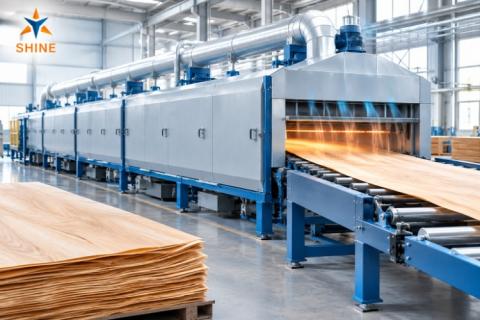
What Is the Best Temperature for Veneer Drying?
So, what is the best temperature for veneer drying? There is no single number for every veneer production line. In industrial veneer drying, operators commonly use temperatures from about 130°C to 200°C, while some high-temperature systems operate above 200°C.
We usually recommend setting the drying temperature according to veneer thickness, wood species, initial moisture content, and dryer design. The goal is simple: remove water quickly without damaging the sheet. After all, nobody wants a beautifully peeled veneer that looks like a potato chip.
A practical temperature range
For many industrial applications, 150°C–180°C provides a useful starting range. However, the correct setting still requires production testing. Some studies have used temperatures from 160°C to 280°C under industrial conditions.
Why Temperature Matters in Veneer Drying
Temperature controls how quickly water leaves the wood. Higher temperatures can reduce drying time, but they also increase the risk of cracks, discoloration, brittleness, and surface changes.
The Forest Products Laboratory reports that commercial dryers can operate at very high temperatures. It also highlights the importance of producing flat veneer with uniform moisture content.
Higher temperature is not always better
It may seem logical to turn up the heat and finish faster. In practice, that approach can cause trouble. High temperatures may damage veneer quality when operators use them without proper control.
Research on birch veneer found significant effects from different drying temperatures on plywood strength and bonding properties.
Match Temperature With Moisture Content
Temperature alone cannot control the entire drying process. We also need to monitor moisture content throughout production. The final target often depends on the adhesive, wood species, panel structure, and storage conditions.
What moisture level should you target?
Many plywood processes dry veneer to roughly 4%–8% moisture content before gluing. Some industrial applications use other targets, so operators should follow their adhesive and panel requirements.
The important point is consistency. Veneer sheets with large moisture differences can create uneven bonding and processing problems.
Control Hot and Humid Air
A good dryer does more than add heat. It moves hot and humid air across the veneer and removes moisture-laden air from the drying chamber. Airflow therefore plays a major role in drying speed and energy use.
Airflow affects drying efficiency
Poor airflow can leave wet areas inside the dryer. Excessive airflow can also increase heat loss and energy consumption. Modern industrial systems use controlled airflow and exhaust management to improve efficiency.
For this reason, we consider temperature, airflow, and exhaust control together rather than separately.
Choose Temperature for Veneer Quality
Different wood species respond differently to heat. Thin veneer also dries much faster than thick veneer. Therefore, one temperature may work well for one product but create defects in another.
Protect quality before chasing speed
Our priority should remain quality veneer that stays flat and performs well during gluing. Excessive heat may increase drying speed, but it can also change color and surface properties.
For industrial veneer, we recommend testing several temperature settings and checking:
- Final moisture content
- Veneer flatness
- Surface cracks
- Color changes
- Bonding performance
- Fuel or electrical consumption
How to Set a Practical Drying Temperature
When we set up a Veneer Dryer Machine, we look at the complete production process. We consider veneer thickness, wood species, initial moisture, production capacity, heat source, and target moisture.
Start carefully, then optimize
A practical starting point may fall around 150°C–180°C for many rotary-cut veneer applications. Then, operators can adjust the temperature based on actual moisture readings and veneer appearance.
If the sheets remain too wet, we can increase temperature, airflow, or residence time. If the sheets become brittle or develop defects, we should reduce the thermal load.
Final Tips for Better Veneer Drying
The best drying temperature balances drying time, veneer quality, and energy consumption. We should not simply choose the highest possible temperature. Instead, we should create stable conditions that produce veneer ready to be glued.
For veneer production, a well-controlled dryer helps manufacturers produce consistent veneer sheets for plywood panels and other wood products. With the right temperature, airflow, and moisture control, we can achieve high quality without wasting energy.
In short:
- Start with a suitable temperature range.
- Monitor moisture content continuously.
- Adjust settings for wood species and thickness.
- Avoid unnecessary high temperatures.
- Check bonding performance before finalizing settings.
- Balance production speed with energy consumption.
That balance is where efficient veneer drying really begins.
- Inicie sesión o registrese para enviar comentarios