
 中文
中文
 English
 Russian
 Thai
Thai
 Indonesian
 Vietnamese
 Portuguese, Portugal
 French
 日本
日本
 Korean
 Hindi
Hindi
 Spanish
 Turkish
 Arabic
 Bahasa Malaysia
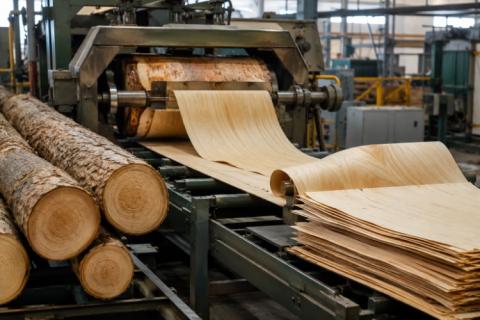
If you have ever looked at a thin wood sheet and wondered where it came from, the answer starts with a log. How Is Veneer Made From Logs? The process combines careful log selection, heating, rotary cutting, clipping, drying, and grading. We find that every stage matters because small mistakes can affect the final product.
At Shine Machinery, we focus heavily on the drying stage. A good peeling process creates the raw material, but controlled veneer drying helps turn wet veneer into a stable product. Let’s follow the journey from a round log to finished wood veneer.
Selecting the Right Veneer Logs
Log quality sets the starting point
Not every log belongs in veneer production. Manufacturers consider species, diameter, length, straightness, knots, decay, and other defects. High-quality logs usually provide better recovery and more attractive grain patterns.
We always say that good veneer starts before the machine starts. A poor log can create checks, holes, uneven thickness, and weak areas. In contrast, carefully selected logs give the production line a much easier job.
Preparing Logs for Cutting
Debarking, heating, and conditioning
Workers first remove bark and cut logs into suitable bolts. Many mills then heat the wood before peeling. Heating softens the wood and can make cutting smoother, especially with certain species.
The treatment method depends on the wood species and production target. Some mills use hot water or steam, while others adjust conditioning time carefully. The goal remains simple: prepare the log for clean cutting without damaging the wood.
Turning Logs Into Veneer Sheets
Rotary cutting creates a continuous ribbon
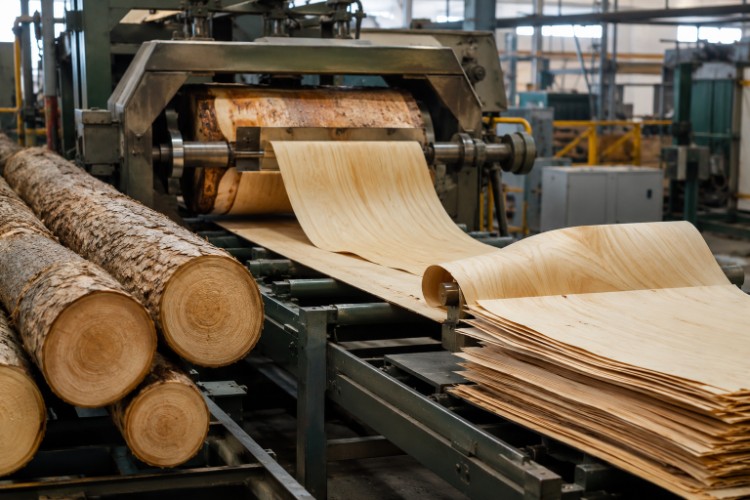
A rotary lathe holds the prepared log and turns it against a knife. The knife removes a continuous layer from the log surface. This rotary cut method can produce long ribbons quickly, making it popular for industrial veneer production.
The veneer thickness depends on the machine setup and application. After peeling, the continuous ribbon passes through clipping equipment. The mill then cuts it into practical dimensions for plywood, LVL, furniture, or other products.
Slicing creates different grain effects
Rotary cutting is not the only method. Manufacturers can also use flat, quarter, rift, or half-round slicing. Each method exposes the wood grain differently and creates a distinct appearance.
For appearance-grade products, grain selection can become almost an art form. For structural products, production efficiency and consistent dimensions often take priority. In other words, the “best” cutting method depends on the job.
Why Wet Veneer Needs Drying
Fresh veneer carries high moisture
Freshly cut veneer contains significant moisture. This wet veneer needs controlled drying before further processing. Excessive moisture content can cause instability, mold, bonding problems, and dimensional changes.
That is where industrial drying equipment becomes essential. A commercial veneer dryer removes moisture quickly while controlling temperature and airflow. We pay close attention to uniform drying because one overly wet area can create trouble later.
Drying affects quality and energy use
The drying process must balance speed, quality, and energy consumption. Dry too slowly, and production loses valuable time. Dry too aggressively, and the veneer may develop defects or uneven moisture.
Research shows that commercial dryers often operate at elevated temperatures. Mechanical systems can use roller, mesh, or jet-based conveying and airflow methods.
Our approach focuses on stable heat transfer and efficient airflow. We want every sheet to leave the dryer ready for the next production stage, not waiting for a second chance.
Organizing and Grading the Veneer
From loose sheets to veneer stacks
After drying, workers inspect and grade the material. They may check thickness, surface quality, color, cracks, knots, and moisture. The mill then sorts suitable sheets according to the intended application.
The finished sheets often form organized veneer stacks. Keeping sheets properly sorted helps manufacturers maintain consistent quality during plywood or LVL production. OSU Extension describes a similar workflow, where mills dry, grade, and organize veneer before producing engineered wood products.
This stage may look simple, but it saves plenty of headaches. Nobody enjoys discovering that the wrong veneer grade reached the glue line.
From Dried Veneer to the Final Product
Veneer becomes a building block
The dried veneer sheets can enter several production routes. Manufacturers may use them for plywood, LVL, furniture components, doors, panels, and decorative surfaces. The final application determines the required thickness, grade, grain pattern, and moisture content.
For structural panels, manufacturers typically combine multiple veneer layers with adhesive. For decorative products, appearance and grain matching may receive greater attention.
From our perspective, the complete process looks like this:
- 🌲 Log selection
- 🔥 Heating and conditioning
- 🌀 Rotary cutting or slicing
- ✂️ Clipping and sizing
- 💨 Drying veneer
- 📏 Moisture and quality inspection
- 📚 Veneer stacking and grading
- 🏭 Panel or furniture production
The journey from log to veneer may look straightforward, but every stage influences the result. High-quality logs help, precise cutting matters, and controlled drying makes a major difference. For us, the real goal is simple: produce stable, uniform veneer with efficient energy use.
A well-designed wood veneer dryer therefore does more than remove water. It helps manufacturers control quality, improve production efficiency, and prepare veneer for reliable downstream processing. That is why we believe good veneer begins with the log, but excellent veneer depends on the entire production line.