
 中文
中文
 English
 Russian
 Thai
Thai
 Indonesian
 Vietnamese
 Portuguese, Portugal
 French
 日本
日本
 Korean
 Hindi
Hindi
 Spanish
 Turkish
 Arabic
 Bahasa Malaysia
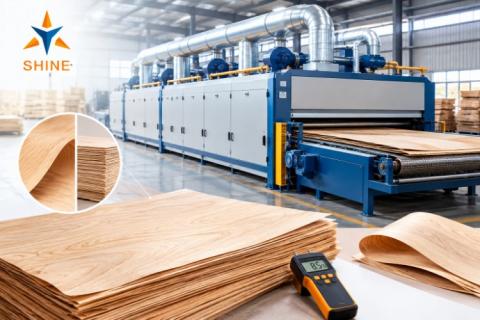
Drying looks simple until a thin sheet of wood starts curling like a potato chip. In real veneer production, moisture control needs much more care. We need to remove excess water while keeping the veneer flat, strong, and ready for gluing.
So, how to dry wood veneer correctly? The answer depends on wood species, thickness, initial moisture content, drying speed, and the final application. In this guide, we explain the practical veneer drying process and the main factors we consider.
Why Do We Need to Dry Wood Veneer?
Fresh Veneer Contains Too Much Water
Fresh wood veneers can contain a large amount of moisture after peeling or slicing. We must remove this excess water before plywood, LVL, or other products can move to the next stage.
The goal is not simply “make it dry.” We want stable veneer moisture, suitable for adhesive application and further processing. FAO notes that plywood veneer commonly dries to around 2–10% moisture content, depending on production needs.
Drying Affects Veneer Quality
Poor drying can create cracks, warping, buckling, or uneven moisture. These problems can later affect gluing and panel performance. Research also shows that both under-dried and over-dried veneer can reduce gluing performance.
How Does Veneer Drying Work?
Step 1: Prepare the Wet Veneer
We first sort and inspect the wet veneer. Thickness, species, sheet size, and initial moisture all matter.
Next, we remove damaged sheets and organize the material for drying. Consistent feeding helps the drying process run smoothly. It also makes the final moisture level easier to control.
Step 2: Apply Controlled Heat and Airflow
A modern Veneer Dryer Machine uses heated air, rollers, or mesh belts to move heat through the veneer. The system removes moisture as hot air passes across the sheet surface.
During drying veneer, we control several factors:
- Drying temperature
- Air velocity
- Drying time
- Feed speed
- Exhaust volume
- Temperature and humidity
- Final moisture target
FAO reports that mechanical dryers can adjust air velocity, temperature, and humidity across different drying zones.
What Temperature Should You Use?
Avoid the “Hotter Is Always Better” Trap
Temperature strongly affects drying speed. However, simply turning up the heat can create new problems. Very rapid drying may cause surface defects or uneven moisture.
Industrial veneer dryers commonly operate at high temperatures. FAO gives roughly 90–160°C as a normal range, while some species can use higher temperatures.
We recommend setting the drying program according to species, thickness, and final use. A poplar veneer and a hardwood veneer may need different settings.
Control Moisture, Not Just Temperature
Temperature tells us how much heat enters the system. It does not tell us whether the veneer has reached the correct final condition.
Therefore, we monitor veneer moisture during production. Sensors and regular moisture checks help us avoid both under-drying and over-drying.
Which Drying Method Works Best?
Air Drying for Small-Scale Production
Air drying offers a simple and low-cost option. We can stack veneers in a suitable area and allow natural airflow to remove moisture.
However, weather controls the process. Rain, humidity, temperature, and airflow can change the drying time dramatically. Quality can also vary between sheets.
Mechanical Drying for Continuous Production
For commercial veneer production, mechanical drying offers much stronger control. Roller and belt systems move veneer continuously through heated zones.
This approach gives us better control over temperature, airflow, and drying time. It also reduces manual handling and supports stable output.
How Can You Reduce Energy Consumption?
Start With the Right Drying Settings
Drying consumes significant thermal energy in plywood manufacturing. FAO reports that veneer drying can account for about 60% of total energy use in plywood production.
That makes efficiency more than a nice bonus. It directly affects production cost.
We normally focus on:
- Correct drying temperature
- Proper airflow
- Suitable feed speed
- Good exhaust control
- Heat recovery
- Efficient burners or heating systems
- Regular equipment maintenance
Modern drying research also highlights heat recovery and process optimization as important ways to improve energy efficiency.
How Do We Check Final Veneer Quality?
Measure Moisture Before Gluing
After veneer drying, we check the final moisture content. A moisture meter provides a quick way to identify wet or over-dried sheets.
We also inspect the veneer for:
- Cracks
- Buckling
- Warping
- Brittle areas
- Uneven drying
- Surface damage
The USDA Forest Products Laboratory identifies fast drying, low cost, flatness, and uniform final moisture as key veneer-drying objectives.
Match the Dryer to Your Production
There is no single drying program for every factory. We consider wood species, veneer thickness, capacity, heating source, target moisture, and available space.
A properly designed Veneer Dryer Machine can help manufacturers achieve stable veneer quality while controlling production costs. The best system should fit the factory rather than force the factory to fit the machine.
Final Thoughts
So, how to dry wood veneer? Start with the right material preparation, then control heat, airflow, humidity, drying time, and final moisture. Do not chase speed alone. Good drying balances productivity, quality, and energy consumption.
At Shine Machinery, we focus on practical drying solutions for different veneer production needs. We believe good drying should make production easier, not turn the factory into a sauna.