
 中文
 English
 Russian
 Thai
 Indonesian
 Vietnamese
 Portuguese, Portugal
 French
 日本
 Korean
 Hindi
 Spanish
 Turkish
 Arabic
 Bahasa Malaysia
What Causes Veneer Shrinkage?
Veneer shrinkage is a natural challenge in plywood manufacturing. It affects sheet dimensions, surface quality, production consistency, and material utilization. However, excessive shrinkage can create unnecessary waste and reduce product value.
At Shandong Shine Machinery, we understand the importance of controlling every stage of veneer drying. We believe manufacturers should understand shrinkage before adjusting their drying equipment. So, what causes veneer shrinkage, and how can factories manage it?
Let's explore the science behind this common production issue and find practical solutions.
1. What Is Veneer Shrinkage?
Veneer shrinkage refers to the reduction in sheet dimensions as wood loses moisture. Freshly peeled veneer contains considerable water inside its cells. During veneer drying, the wood gradually releases this moisture and changes its dimensions.
This process involves more than simple water evaporation. Wood cell walls also lose bound water, which causes the material to contract. As a result, manufacturers may notice changes in veneer width, length, and thickness.
Three types of dimensional changes deserve attention:
- Tangential shrinkage: Movement along the growth rings.
- Radial shrinkage: Movement across the growth rings.
- Longitudinal shrinkage: Movement parallel to the wood grain.
Wood generally shrinks more tangentially than radially. Longitudinal shrinkage usually remains much smaller. However, actual results depend on species, grain structure, and drying conditions.
2. What Causes Veneer Shrinkage?
Several factors influence how much a veneer sheet shrinks. Some relate to the natural properties of wood, while others come from factory operations.
2.1 Moisture Content Changes
Moisture content plays the most important role in wood shrinkage. Freshly peeled veneer often contains both free water and bound water. Free water occupies cell cavities, while bound water remains inside cell walls.
Removing free water does not normally cause significant shrinkage. However, the situation changes when moisture content falls below the fiber saturation point. This point often occurs around 30%, although different species show some variation.
As the cell walls lose bound water, they contract. Therefore, greater moisture loss below this point generally produces greater shrinkage.
2.2 Different Wood Species
Not every wood species shrinks at the same rate. Their density, cell structure, grain direction, and natural properties influence dimensional changes.
For example, hardwoods and softwoods can show different shrinkage characteristics. Even two species within the same category may behave differently. Some dense hardwoods experience considerable dimensional changes during drying.
We recommend testing different species before establishing standard drying parameters. This simple step helps factories avoid unnecessary adjustments and production losses.
2.3 Excessive Drying Temperature
Temperature strongly influences moisture evaporation. Higher temperatures can accelerate veneer drying and improve production speed. However, excessive heat may create an unstable drying process.
When the surface loses moisture much faster than the interior, moisture gradients develop. These differences can create internal stresses and increase the risk of checking, deformation, and uneven shrinkage.
We recommend adjusting temperature according to veneer thickness, species, and initial moisture content. Higher temperatures do not automatically mean better production.
2.4 Uneven Airflow Inside the Dryer
Airflow determines how evenly hot air reaches each veneer sheet. Poor circulation can create different drying conditions across the production line.
For example, some areas may receive stronger airflow than others. Consequently, certain sheets lose moisture faster and experience greater dimensional changes.
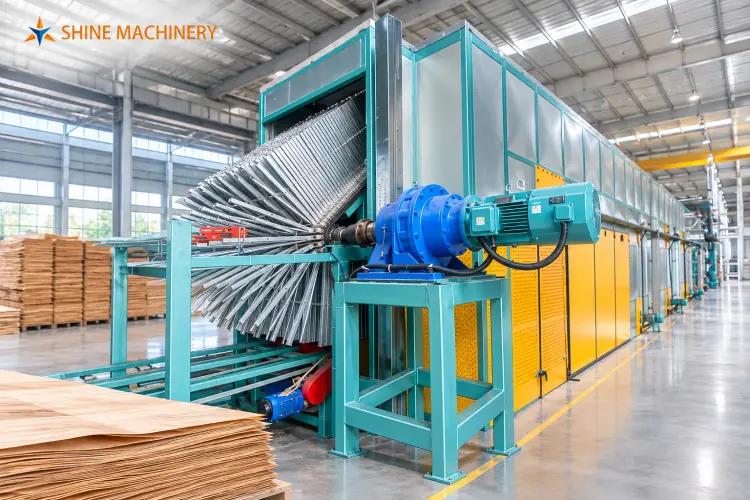
A well-designed Veneer Dryer Machine should maintain stable airflow throughout its drying sections. Regularly checking fans, air passages, and filters also helps maintain consistent performance.
2.5 Veneer Thickness and Initial Quality
Veneer thickness affects moisture movement and drying speed. Thick veneers generally require more time to release moisture from their inner layers. Thin veneers usually respond faster to changes in temperature and airflow.
Initial veneer quality also matters. Irregular grain, natural defects, and uneven thickness can produce inconsistent drying behavior. Therefore, we suggest sorting raw materials before feeding them into the drying line.
3. How Does Veneer Shrinkage Affect Production?
Shrinkage does not always indicate a production failure. However, excessive or uneven shrinkage can create several manufacturing problems.
Common consequences include:
- Dimensional inconsistency: Sheets may no longer meet required size specifications.
- Surface defects: Uneven contraction can contribute to checking and cracking.
- Assembly difficulties: Different sheet dimensions can complicate veneer matching and plywood lay-up.
- Material waste: Excessive shrinkage can reduce usable sheet dimensions.
- Bonding problems: Moisture differences between veneer layers may create stress during pressing.
These problems can affect both production efficiency and finished plywood quality. Therefore, manufacturers should monitor shrinkage alongside final moisture content.
4. How Can Manufacturers Control Veneer Shrinkage?
Although factories cannot eliminate natural wood shrinkage, they can manage it effectively. In our experience, stable operating conditions and accurate moisture control make a significant difference.
4.1 Set Suitable Drying Parameters
Manufacturers should develop drying schedules for different wood species and thicknesses. Avoid using identical temperature settings for every batch. Instead, adjust temperature, airflow, and feeding speed according to actual material conditions.
A practical drying schedule should consider:
- Initial moisture content (%).
- Veneer thickness (mm).
- Drying temperature (°C).
- Feeding speed (m/min).
- Final moisture content (%).
4.2 Monitor Final Moisture Content
A moisture meter helps operators check whether veneer has reached its target condition. We recommend testing samples from different positions across the drying line. This approach provides a clearer picture than checking only one sheet.
Manufacturers should also establish suitable moisture targets for their adhesive systems and final applications. Consistent moisture levels help reduce dimensional differences during storage and pressing.
4.3 Maintain Stable Airflow
Regular equipment maintenance supports consistent drying performance. Operators should inspect circulation fans, filters, air ducts, and temperature sensors. They should also remove accumulated dust and debris from important airflow passages.
These routine checks help prevent local overheating and uneven moisture removal. More importantly, they keep production conditions stable over the long term.
4.4 Choose Suitable Drying Equipment
A suitable drying system should match the factory's production capacity and raw material requirements. Important considerations include temperature control, airflow distribution, feeding speed, and energy efficiency.
At Shandong Shine Machinery, we focus on practical drying solutions for veneer manufacturers. Our goal is to help customers improve production consistency while managing operating costs. The right equipment should support stable drying rather than simply maximize heating power.
5. Does Veneer Shrinkage Stop After Drying?
Not necessarily. Wood remains a hygroscopic material, which means it exchanges moisture with surrounding air. Changes in temperature and relative humidity can cause dried veneer to absorb or release moisture.
Consequently, veneer may continue shrinking or swelling during storage. Poor storage conditions can also create moisture differences between sheets. We recommend keeping dried veneer in a clean, dry environment with controlled humidity.
Proper packaging and suitable storage practices also help protect finished materials. Remember, the drying process does not end when the sheets leave the machine.
Conclusion
So, what causes veneer shrinkage? The main factors include moisture loss, wood species, temperature, airflow, and veneer thickness. Although manufacturers cannot completely prevent natural shrinkage, they can control many factors behind excessive dimensional changes.
We believe successful veneer production starts with understanding raw materials and maintaining stable drying conditions. A suitable drying system, accurate moisture monitoring, and regular maintenance all contribute to better results.
Are you looking for a reliable drying solution for your plywood factory? Contact Shandong Shine Machinery to discuss your production requirements. We would be glad to help you find a suitable veneer drying solution.