
 中文
中文
 English
 Russian
 Thai
Thai
 Indonesian
 Vietnamese
 Portuguese, Portugal
 French
 日本
日本
 Korean
 Hindi
Hindi
 Spanish
 Turkish
 Arabic
 Bahasa Malaysia
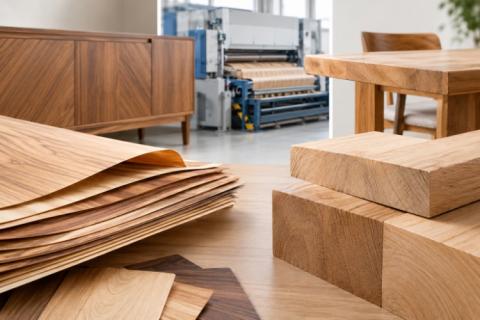
Veneer vs Solid Wood: The Basics
When people compare Veneer vs Solid Wood, they often expect one clear winner. We understand why. After all, both materials bring the warmth and beauty of real wood into homes, offices, hotels, and commercial spaces. However, the better choice depends on the furniture design, budget, performance needs, and desired appearance.
Veneer uses thin slices of natural wood over a stable substrate. Solid wood uses timber throughout the main body of a component. Both options can deliver a high quality appearance when manufacturers select good materials and use proper production methods. So, instead of asking which material wins, we should ask where each material performs best.
What Exactly Is Wood Veneer?
Wood veneer comes from real logs, not printed paper or plastic. Manufacturers peel or slice logs into thin sheets with controlled thickness. These sheets preserve the original species, color, texture, and grain pattern of the timber.
We particularly like veneer because it lets manufacturers use valuable species more efficiently. One log can create many decorative surfaces instead of becoming only one thick board. That makes veneer especially useful for large panels and modern furniture designs.
Understanding Solid Wood Furniture
Solid wood has a straightforward structure. A solid wood piece contains natural timber through its thickness, rather than a thin decorative layer. Manufacturers commonly use it for tables, chairs, bed frames, cabinet frames, and other structural components.
Strength and Natural Character
Many buyers choose solid wood furniture because every board looks slightly different. Knots, color shifts, growth rings, and small natural marks give each piece of wood its own personality. Frankly, that character can make a room feel less like a showroom and more like a home.
Solid wood also allows repeated sanding and refinishing in many applications. However, wood responds to changes in moisture and humidity. The USDA Forest Products Laboratory notes that moisture changes can cause dimensional movement in wood products.
Where Solid Wood Works Best
Solid timber works well when a project needs substantial material thickness and a traditional appearance. Dining tables provide a good example. A thick wooden tabletop can showcase natural character while offering a surface that owners can refinish.
Still, solid timber does not automatically mean better quality. Good design, correct moisture control, joinery, finishing, and material selection matter just as much. A poorly designed solid board can cause more headaches than a well-made veneered panel.
Why Choose Veneer Furniture?
A Smart Use of Natural Timber
Veneer offers an interesting combination of appearance, efficiency, and design freedom. Manufacturers can use thin layers of attractive wood over plywood, MDF, or another suitable substrate. This approach reduces the amount of premium timber needed for broad surfaces.
For customers, that can make veneer furniture more cost effective. Expensive species can become accessible without covering an entire cabinet with thick solid boards. We see this as one of veneer’s biggest advantages.
More Freedom With Grain Patterns
Designers can arrange veneer sheets to create striking visual effects. Book matching, slip matching, and sequence matching can produce balanced patterns across cabinet doors and wall panels.
This matters when a project needs consistency. A large piece of furniture can maintain a coordinated appearance across multiple panels. With solid boards, natural variation can make exact matching much harder.
Veneer vs Solid Wood: Cost and Value
Which Material Costs More?
There is no universal price winner. Timber species, thickness, grade, construction, finishing, and production methods all influence the final price. However, veneer often provides better material efficiency for large decorative surfaces.
Imagine covering a large cabinet with premium walnut. Using thick walnut boards could consume considerable quantities of valuable timber. A walnut veneer surface can provide a similar visual impression while using a much thinner layer.
That does not mean veneer always costs less. High-end decorative veneer requires careful cutting, drying, matching, pressing, and finishing. In some luxury projects, skilled veneer work can become a premium feature rather than a budget shortcut.
How Veneer Drying Affects Quality
Why Moisture Control Matters
Drying plays an important role in veneer production. Freshly peeled veneer contains substantial moisture and requires controlled drying before many downstream processes. FAO guidance explains that veneer drying supports gluing and production quality, while controlled drying can improve uniformity.
Our team pays close attention to this stage because poor drying can create unnecessary problems. Uneven moisture may contribute to defects, bonding issues, and inconsistent processing. Research also shows that veneer moisture content strongly influences bonding and mechanical properties.
The Role of a Veneer Dryer Machine
A modern Veneer Dryer Machine controls key drying conditions such as temperature, airflow, and drying time. Continuous dryers can move veneer sheets through different drying zones. Operators can adjust these zones to suit different wood species and production requirements.
According to FAO, veneer drying can consume a major share of energy in plywood production. Proper dryer design therefore affects both production efficiency and operating costs.
For us, efficient drying means more than removing water. We want stable moisture, consistent quality, lower energy waste, and reliable production. That is where equipment engineering becomes just as important as the raw material.
Wood and Veneer: Can They Work Together?
The Best Furniture May Use Both
Here comes the unexpected part: you do not always need to choose between veneer and solid wood. Many well-designed products combine both materials.
For example, a cabinet may use solid timber for its frame and veneer for its large door panels. A dining table may combine a solid wood edge with a veneered central panel. This approach uses each material where it performs best.
We call this practical rather than ideological. Wood and veneer can complement each other beautifully when designers understand their different properties.
A Practical Comparison
|
Feature |
Veneer |
Solid Wood |
|
Material efficiency |
★★★★★ |
★★★ |
|
Natural appearance |
★★★★★ |
★★★★★ |
|
Grain matching |
★★★★★ |
★★★ |
|
Large panels |
★★★★★ |
★★★ |
|
Refinishing potential |
★★★–★★★★★* |
★★★★★ |
|
Cost control |
★★★★★ |
★★★ |
|
Design flexibility |
★★★★★ |
★★★★ |
|
Natural variation |
Medium |
High |
*Refinishing depends on veneer thickness and construction.
Veneer vs Solid Wood: Which Should You Choose?
Choose Based on the Application
For traditional tables, chairs, frames, and thick structural parts, solid wood can make an excellent choice. It offers authentic character and substantial material depth. For large decorative panels, cabinets, doors, and coordinated surfaces, veneer can offer stronger material efficiency.
We believe the smartest approach starts with the project rather than the label. Consider these factors before making a decision:
- Budget: Choose the material that delivers the best value.
- Appearance: Decide whether you want natural variation or matched grain.
- Dimensions: Consider how large the panels need to become.
- Durability: Match the material to the expected use.
- Humidity: Consider the environment where the furniture will live.
- Maintenance: Think about future sanding and refinishing.
- Sustainability: Consider how efficiently the project uses valuable timber.
Ultimately, Veneer vs Solid Wood is not a battle between good and bad materials. Both have important roles in modern woodworking. We prefer to see them as two different tools in the same toolbox.
The best result comes from choosing the right piece of wood, the right construction method, and the right production process. And sometimes, the cleverest furniture uses a little of both.