
 中文
中文
 English
 Russian
 Thai
Thai
 Indonesian
 Vietnamese
 Portuguese, Portugal
 French
 日本
日本
 Korean
 Hindi
Hindi
 Spanish
 Turkish
 Arabic
 Bahasa Malaysia
What Affects Veneer Drying Speed?
Veneer drying plays a vital role in modern plywood production. However, not every sheet dries at the same speed, even under similar conditions. Wood species, initial moisture content, drying temperature, and airflow all influence the final result. At Shandong Shine Machinery, we understand these challenges and help manufacturers improve drying efficiency without sacrificing veneer quality.
So, what affects veneer drying speed most? The answer involves several connected factors. By understanding them, manufacturers can optimize the drying process, reduce energy consumption, and achieve more consistent results.
1. Initial Veneer Moisture Content
Initial moisture content directly affects how long wood veneers need to dry. Freshly peeled veneer often contains a large amount of water. Therefore, the dryer must remove more moisture before the sheets reach their target level.
For example, veneer with an initial moisture content of 80% generally requires more drying effort than veneer starting at 45%. However, actual drying time also depends on wood species, thickness, and equipment settings. Operators should measure moisture regularly instead of relying on visual appearance alone.
Why Moisture Measurement Matters
We recommend checking moisture content at several production stages. Consistent measurements help operators adjust drying parameters before problems develop. They also prevent unnecessary drying, which wastes energy and may damage the veneer surface.
- High initial moisture: Usually increases drying time and energy demand.
- Uneven moisture: Can produce inconsistent results across veneer sheets.
- Excessive drying: May cause brittleness, cracking, or unnecessary energy consumption.
2. Wood Species and Veneer Thickness
Different wood species release moisture at different rates. Their density, cellular structure, and permeability influence how water moves through the wood. Consequently, two veneers with identical thicknesses may require different drying schedules.
Veneer thickness also plays a major role. Thicker sheets generally need more time because moisture must travel farther before escaping. Thin sheets usually dry faster, but they can become brittle if operators apply excessive heat.
Finding the Right Balance
During veneer production, manufacturers should consider both species and thickness when setting drying parameters. For instance, a drying schedule suitable for thin poplar veneer may not suit thicker hardwood veneer. We encourage operators to test representative samples before changing production settings.
A suitable schedule balances drying speed with sheet quality. Faster drying sounds attractive, but damaged veneer can create greater losses downstream.
3. Drying Temperature and Heat Transfer
Drying temperature strongly influences evaporation. Higher temperatures generally accelerate moisture removal by supplying more heat to the veneer. Nevertheless, increasing temperature without considering other conditions can create new problems.
Excessive heat may cause surface checking, discoloration, or uneven moisture distribution. It can also increase defects when the veneer dries too quickly at the surface. Therefore, operators should select temperatures according to wood species, thickness, and target moisture content.
How Temperature Affects Drying Performance
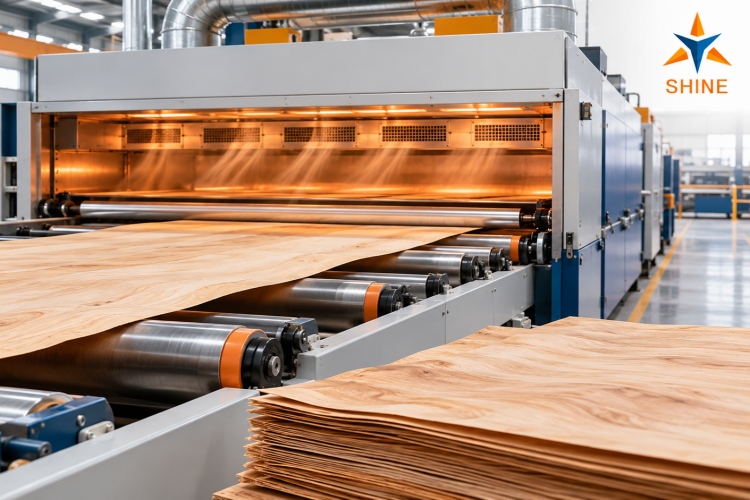
A well-designed Veneer Dryer Machine distributes heat throughout the drying chamber. Its heating system should maintain stable temperatures across different sections. This consistency helps manufacturers achieve predictable results during continuous production.
Operators should monitor:
- Inlet temperature: The temperature of incoming drying air.
- Chamber temperature: Heat conditions across the drying zones.
- Outlet temperature: An indicator of heat transfer and operating conditions.
- Final moisture content: A key measure of drying performance.
The ideal settings depend on the equipment design and production requirements. We recommend adjusting one parameter at a time and recording the results.
4. Airflow and Hot and Humid Air
Heat alone cannot guarantee fast drying. Airflow must also carry evaporated moisture away from the veneer surface. Without sufficient circulation, humid air accumulates and slows further evaporation.
Hot and humid air becomes less effective at removing moisture when it cannot escape or circulate properly. Meanwhile, uneven airflow can leave some sheets damp while others become overdried. These differences create quality problems and complicate later pressing processes.
Why Air Distribution Matters
A well-designed drying system distributes air evenly across the veneer sheets. Fans, ducts, circulation passages, and exhaust systems all influence performance. Regular inspection helps operators identify blocked passages, damaged fans, or other airflow problems.
For better results, manufacturers should:
- Maintain clean air passages and ventilation openings.
- Check fan performance and air distribution regularly.
- Monitor exhaust conditions and remove excess humidity.
- Avoid overloading the dryer beyond its designed capacity.
Effective circulation supports faster moisture removal and more stable production. It also helps reduce unnecessary heat loss.
5. Veneer Drying Conditions and Equipment Design
The overall veneer drying conditions determine how efficiently a dryer converts heat into useful moisture removal. Temperature, airflow, humidity, feeding speed, and heating capacity work together. A weakness in one area can limit the entire system.
Equipment design also affects productivity. Roller spacing, heating zones, chamber insulation, and air circulation influence how evenly the machine handles each sheet. A properly configured system helps manufacturers maintain consistent output across long production runs.
Choosing Suitable Drying Parameters
We advise manufacturers to evaluate equipment according to their actual production needs. Important considerations include veneer thickness, target moisture content, required capacity, and available heat sources. These factors help determine suitable operating conditions and machine configurations.
Operators should also record production data, including:
- Feeding speed and hourly output.
- Inlet and outlet moisture measurements.
- Temperature readings across different zones.
- Energy consumption per unit of dried veneer.
- Defect rates and rejected sheets.
These records reveal trends that operators might otherwise overlook. They also provide a practical foundation for improving drying efficiency.
6. Target Moisture Content and Final Veneer Quality
Drying speed matters, but the final moisture content matters just as much. Veneer that leaves the dryer too wet may cause problems during gluing and hot pressing. Excess moisture can affect adhesive performance and contribute to steam-related defects in plywood panels.
On the other hand, overdried veneer may become brittle and more difficult to handle. Cracks and broken edges can increase waste during subsequent processing. Therefore, manufacturers should define a suitable moisture target for their products and adhesive systems.
Preparing Veneer for Gluing and Hot Pressing
The correct target depends on wood species, adhesive type, and manufacturing requirements. Operators should verify the moisture level before the veneer enters downstream processes. Consistent moisture helps improve bonding reliability and supports high quality veneer production.
In industrial veneer applications, quality control should cover both moisture content and physical condition. A sheet may appear dry while retaining moisture differences across its surface. Regular sampling helps detect these hidden variations before they affect the finished product.
7. How to Reduce Veneer Drying Time
Reducing drying time requires more than simply increasing temperature. Manufacturers should improve the complete drying process while protecting product quality. A few practical adjustments can deliver meaningful gains.
We recommend the following actions:
- Control incoming moisture: Sort or monitor veneer batches with different moisture levels.
- Optimize temperature: Match heat settings to wood species and thickness.
- Improve airflow: Keep fans, ducts, and exhaust systems in good condition.
- Adjust feeding speed: Avoid rushing sheets through the dryer before they reach the target.
- Reduce heat loss: Inspect insulation, seals, and other potential leakage points.
- Track energy consumption: Compare energy use with production output and final moisture levels.
- Maintain equipment: Schedule inspections to prevent performance losses and unexpected downtime.
Manufacturers should evaluate each adjustment using real production data. The best improvement is one that reduces drying time without increasing defects or operating costs.
8. Why Drying Speed Matters in Plywood and LVL Production
Efficient veneer drying supports the entire wood manufacturing line. In plywood production, stable moisture content helps manufacturers prepare veneer for adhesive application and hot pressing. It also reduces the risk of defects that can lower finished panel quality.
Similarly, LVL production depends on consistent veneer preparation before adhesive application and pressing. Uneven moisture can affect process stability and increase material waste. By improving drying control, manufacturers can support more reliable production and better resource utilization.
A balanced drying process also improves production planning. When operators understand drying time and moisture variation, they can coordinate upstream peeling with downstream gluing. This reduces bottlenecks and helps factories use their equipment more effectively.
Conclusion: Faster Drying, Better Results
What affects veneer drying speed? The main factors include initial moisture content, wood species, thickness, drying temperature, airflow, equipment design, and target moisture levels. Each factor influences the others, so manufacturers should optimize them as a complete system.
At Shandong Shine Machinery, we believe efficient drying should deliver more than speed. It should protect veneer quality, control energy consumption, and support stable industrial production. With suitable equipment, careful monitoring, and well-planned operating conditions, manufacturers can achieve reliable drying results and improve long-term productivity.