
 中文
 English
 Russian
 Thai
 Indonesian
 Vietnamese
 Portuguese, Portugal
 French
 日本
 Korean
 Hindi
 Spanish
 Turkish
 Arabic
 Bahasa Malaysia
Why Veneer Breaks During Drying?
Veneer breakage during drying creates headaches for plywood manufacturers. A small crack can quickly turn valuable raw material into production waste. Worse still, broken veneer can interrupt feeding, reduce production efficiency, and increase labor costs.
So, why does veneer break during drying? The answer usually involves several factors. Excessive heat, uneven moisture content, poor air circulation, and improper drying speed can all contribute. Wood species and veneer thickness also influence the final result.
At Shandong Shine Machinery, we understand these challenges. We know that every sheet matters in a busy plywood factory. Therefore, we want to explain the main causes of veneer breakage and share practical ways to prevent them.
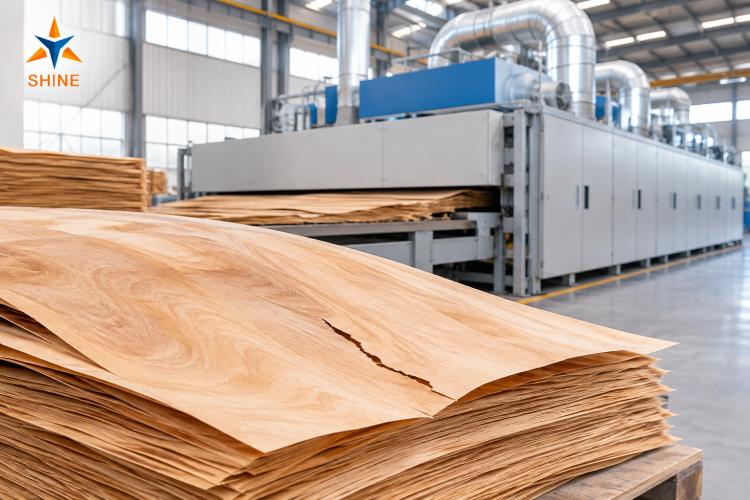
1. What Causes Veneer to Break During Drying?
Veneer breakage rarely happens without a reason. Sometimes, the problem starts before the sheets enter the dryer. In other cases, incorrect operating conditions create damage during the drying process.
Let's examine the most common causes.
1.1 Excessive Veneer Drying Temperature
Temperature plays a major role in veneer quality. When operators set the drying temperature too high, moisture escapes rapidly from the wood surface. However, the inner layers may still contain considerable water.
This difference creates internal stress. The surface contracts faster than the inner material, which increases the risk of cracks. Under severe conditions, small wood veneer cracks can develop into complete breaks.
High temperatures can also damage the wood structure. Research has shown that severe drying conditions can make veneer more brittle. Therefore, faster drying does not always mean better production.
1.2 Uneven Moisture Content
Different parts of a veneer sheet rarely contain exactly the same amount of water. Natural wood variations, peeling conditions, and storage environments all affect initial moisture content.
When one area dries faster than another, uneven shrinkage occurs. This creates drying stress in wood and places additional tension on weaker areas. Eventually, the sheet may develop cracks or split into separate pieces.
For example, a wet section may remain flexible while a dry section becomes stiff. The difference makes the veneer vulnerable during transportation and handling.
1.3 Veneer Overdrying
Overdrying is another common reason for veneer cracking. During normal drying, wood gradually loses moisture and becomes lighter. However, excessive moisture removal can reduce its flexibility.
When veneer becomes brittle, even minor mechanical pressure can cause damage. Conveyor rollers, stacking equipment, and manual handling may trigger breaks. Thin sheets face an even greater risk.
Overdrying also wastes energy and reduces production efficiency. In short, nobody wants to pay extra electricity costs for weaker products.
1.4 Excessive Drying Speed
Every veneer sheet needs enough time to release moisture evenly. If operators increase the feeding speed without adjusting other parameters, the drying process may become unstable.
However, extremely slow drying also creates unnecessary production costs. The goal is not simply to dry faster or slower. Instead, manufacturers must find a suitable balance between drying speed, temperature, and airflow.
A properly adjusted drying cycle helps maintain consistent moisture levels. It also reduces the risk of veneer drying defects.
1.5 Poor Hot Air Circulation
Hot air circulation directly affects drying uniformity. When airflow becomes uneven, some areas receive more heat than others.
Blocked air passages, dirty filters, and poorly balanced fans can cause this problem. As a result, certain veneer sections may overdry while others remain too wet.
This condition creates different shrinkage rates across the sheet. Eventually, the resulting stress can cause veneer splitting or surface cracks.
1.6 Raw Material and Veneer Thickness
Not all wood species behave in the same way. Some species contain different fiber structures and respond differently to heat and moisture loss.
Veneer thickness also matters. Thin veneer usually dries faster than thick veneer under similar conditions. Therefore, applying identical settings to every material may produce inconsistent results.
Poor peeling conditions can create another problem. Existing splits, weak grain areas, and mechanical damage may become more obvious during drying.
2. How Does the Veneer Drying Process Cause Breakage?
Understanding the drying mechanism helps manufacturers identify problems earlier. Wood contains moisture inside its cell walls and internal spaces. Heat transfers energy into the material, while moving air carries away evaporated moisture.
During this process, the surface usually loses moisture before the inner section. This creates a moisture gradient between different areas. When shrinkage occurs unevenly, internal stress increases.
2.1 The Relationship Between Moisture and Shrinkage
Veneer moisture content affects flexibility, strength, and dimensional stability. Freshly peeled veneer often contains considerable water. The dryer must remove enough moisture for the next manufacturing stage.
However, excessive moisture removal can cause unnecessary shrinkage. Different wood fibers may also respond differently to changing moisture levels.
Manufacturers should monitor several important factors:
- Initial moisture content (%).
- Target final moisture content (%).
- Veneer thickness (mm).
- Drying temperature (°C).
- Conveyor speed (m/min).
- Relative humidity (%).
These parameters work together. Changing one parameter without considering the others may create unexpected drying problems.
2.2 Temperature and Drying Stress
Temperature controls how quickly moisture moves out of veneer. Higher temperatures can shorten drying time, but they also increase the risk of excessive drying.
Scientific research has examined veneer drying temperatures around 160°C and higher. Some industrial processes also use temperatures above 200°C. However, suitable settings depend on wood species, thickness, equipment design, and exposure time.
Manufacturers should never copy another factory's temperature settings blindly. A successful drying program must match the actual raw material and production requirements.
2.3 Why Dry Veneer Breaks During Handling
Sometimes, veneer leaves the dryer without obvious damage. Yet workers discover cracks during sorting, stacking, or gluing.
Why does this happen? The answer may involve excessive drying and reduced flexibility. Brittle veneer cannot tolerate the same mechanical pressure as properly dried material.
Frequent bending, sharp contact points, and improper stacking can make the situation worse. Therefore, manufacturers should inspect veneer both before and after drying.
3. How to Prevent Veneer from Breaking During Drying
Preventing veneer breakage requires more than lowering the temperature. Manufacturers need a consistent process that controls moisture, heat, airflow, and material handling.
Here are six practical methods.
3.1 Set the Correct Drying Temperature
Start by checking the wood species and veneer thickness. Then adjust the temperature according to the material's drying characteristics.
Avoid sudden temperature increases without testing. Instead, establish suitable settings through small production trials. Record the results and compare the final veneer quality.
A stable temperature profile helps reduce excessive surface drying. It also improves consistency between different production batches.
3.2 Control Final Moisture Content
Do not judge drying quality by appearance alone. Use moisture meters to check the actual moisture content.
Take samples from different positions across the dryer. Compare the results to identify possible moisture differences. If some sheets become too dry, adjust the drying conditions before processing another batch.
The target moisture content depends on wood species and adhesive requirements. For example, research on plywood production has reported different optimum values for poplar and spruce veneer.
Therefore, manufacturers should establish their own moisture standards through testing.
3.3 Adjust Conveyor Speed
Conveyor speed determines how long veneer stays inside the drying chamber. A faster speed reduces exposure time, while a slower speed increases it.
However, the correct setting depends on several conditions. These include initial moisture, thickness, temperature, and airflow.
We recommend testing different speed settings with representative veneer samples. Record the final moisture content and inspect the sheets for cracks. This approach helps operators find a practical balance between quality and production capacity.
3.4 Improve Hot Air Circulation
Uniform airflow helps every section of veneer receive consistent drying conditions. Check fans, air ducts, filters, and circulation passages regularly.
Remove dust and other materials that block airflow. Also, inspect fan performance and look for abnormal pressure differences.
A well-maintained air circulation system reduces local overheating. It also helps prevent uneven moisture content across veneer sheets.
3.5 Sort Veneer Before Drying
Good drying starts with proper material preparation. Separate veneer according to thickness, wood species, and initial moisture content whenever possible.
Avoid mixing materials with significantly different drying requirements. Otherwise, one temperature and speed setting may not suit every sheet.
Operators should also remove severely damaged veneer before feeding. Existing cracks may expand during drying and create larger production losses.
3.6 Handle Dried Veneer Carefully
The drying process does not end when veneer leaves the machine. Proper cooling, conveying, stacking, and storage also protect product quality.
Avoid excessive bending and unnecessary mechanical pressure. Keep sharp edges away from delicate sheets. Furthermore, store dried veneer under suitable environmental conditions.
These simple steps help reduce breakage during later production stages.
4. How an Industrial Veneer Dryer Helps Reduce Breakage
Equipment performance plays an important role in drying quality. A well-designed industrial veneer dryer provides more consistent heating, airflow, and material transportation.
At Shandong Shine Machinery, we focus on practical equipment solutions for plywood manufacturers. Our drying equipment supports continuous production and helps operators manage important drying parameters.
4.1 More Consistent Temperature Control
A suitable heating system helps maintain stable operating conditions. Operators can adjust temperature settings according to different wood materials and production requirements.
This reduces unnecessary temperature fluctuations. It also helps prevent excessive heat exposure during the drying cycle.
4.2 Uniform Hot Air Circulation
A properly designed circulation system distributes heated air throughout the drying chamber. Consistent airflow helps reduce local overheating and uneven drying.
As a result, manufacturers can achieve better moisture consistency. This also helps lower the risk of cracking and other veneer drying defects.
4.3 Continuous Feeding and Speed Adjustment
A continuous veneer dryer moves sheets through different drying zones. Operators can adjust conveyor speed according to material conditions.
This arrangement supports stable production and reduces unnecessary manual handling. It also helps manufacturers maintain consistent drying conditions across production batches.
4.4 Better Production Efficiency
An efficient drying system helps manufacturers reduce material waste and energy consumption. It also supports smoother coordination between veneer peeling, drying, and plywood pressing.
However, equipment alone cannot eliminate every drying defect. Correct operating parameters and regular maintenance remain essential.
5. Why Veneer Quality Matters in Plywood Manufacturing
Veneer drying directly affects the next stages of the plywood manufacturing process. Poorly dried sheets may create difficulties during gluing and hot pressing.
For example, excessive moisture can interfere with adhesive performance. Overdried veneer may become brittle and break during splicing. Both situations can reduce production efficiency.
Consistent veneer quality helps manufacturers achieve several benefits:
- Lower raw material waste.
- Fewer broken veneer sheets.
- More stable gluing conditions.
- Better production continuity.
- Improved plywood quality.
- More efficient energy consumption.
Therefore, manufacturers should treat drying as a key quality-control stage. Good veneer preparation and accurate drying parameters create a stronger foundation for finished plywood.
Conclusion
So, why does veneer break during drying? Excessive temperature, uneven moisture content, overdrying, poor airflow, and unsuitable drying speed are common causes.
The solution starts with understanding the material. Manufacturers should control temperature, monitor moisture, adjust conveyor speed, and maintain uniform hot air circulation.
At Shandong Shine Machinery, we believe reliable drying equipment should support both product quality and production efficiency. With suitable equipment and well-managed operating conditions, manufacturers can reduce veneer breakage and improve material utilization.
Looking for a reliable drying solution for your plywood factory? Contact our team to discuss your production requirements and find a suitable veneer drying system.