
 中文
 English
 Russian
 Thai
 Indonesian
 Vietnamese
 Portuguese, Portugal
 French
 日本
 Korean
 Hindi
 Spanish
 Turkish
 Arabic
 Bahasa Malaysia
What Is Plywood Made Of? A Complete Guide
Plywood is one of the most widely used wood products in modern construction and furniture manufacturing. You can find it in floors, walls, cabinets, doors, roofs, and packaging. But have you ever wondered what makes this simple-looking wood panel so strong?
Unlike solid wood, plywood does not come from one solid piece of timber. Manufacturers combine several thin layers of wood veneer with specialized adhesives. They then apply heat and pressure to create strong, stable plywood panels.
At Shandong Shine Machinery, we understand the importance of every manufacturing stage. From raw wood preparation to veneer drying, each process affects the final panel quality. In this guide, we will explore what plywood is made of and how manufacturers turn raw timber into a reliable engineered wood product.
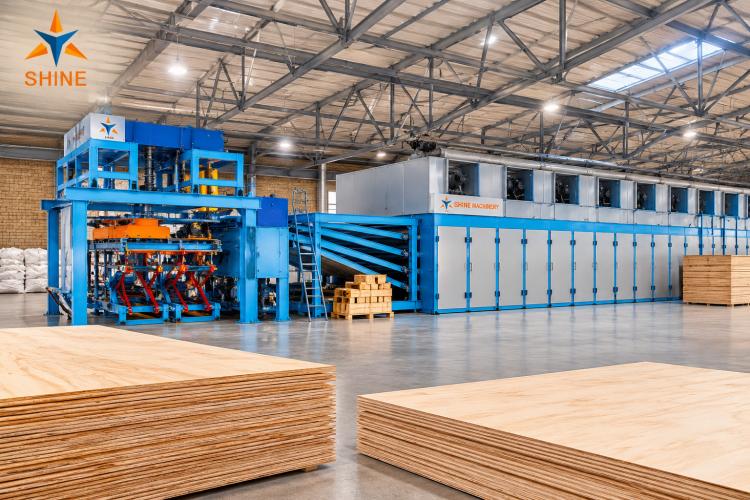
1. What Is Plywood Made Of?
Plywood mainly consists of three essential components: wood veneer, adhesive, and core materials. These components work together to create a durable and versatile panel.
Most traditional plywood contains an odd number of veneer layers. Manufacturers arrange these layers with alternating grain directions. This structure improves stability and distributes mechanical stress across the panel.
Here are the main materials used in plywood production:
- Wood veneer: Thin sheets of natural wood that form the main structure.
- Adhesive: Special glue that bonds individual veneer layers.
- Core materials: Inner layers that provide thickness, strength, and support.
- Surface veneer: Outer layers that determine appearance and surface quality.
The exact combination depends on the plywood application, production standards, and required performance.
1.1 Wood Veneer: The Main Raw Material
Wood veneer forms the foundation of traditional plywood. Manufacturers produce it by peeling or slicing natural logs into thin sheets.
These thin layers usually measure approximately 0.5–3.0 mm thick. However, actual thickness depends on the wood species and product specifications.
Common wood species include:
- Poplar: Lightweight, easy to process, and widely available.
- Pine: Offers good structural performance and natural durability.
- Birch: Provides a smooth surface and excellent strength.
- Eucalyptus: Combines good density with mechanical performance.
- Oak: Offers attractive grain patterns and good hardness.
- Maple: Provides a clean appearance for decorative applications.
Each species has different physical properties. Therefore, manufacturers select suitable materials according to the intended application.
For example, furniture manufacturers often prefer attractive hardwood veneers. Construction companies may choose softwood veneers for structural applications.
1.2 Adhesives: What Holds Plywood Together?
Wood veneer provides the structure, but adhesive holds everything together. Without suitable bonding materials, individual layers cannot form a reliable panel.
Manufacturers select adhesives according to moisture exposure, bonding strength, and product requirements.
Common plywood adhesives include:
Urea-Formaldehyde (UF)
UF adhesive works well for interior plywood. It offers fast curing, good bonding performance, and relatively low production costs. However, it does not provide sufficient water resistance for permanent outdoor exposure.
Phenol-Formaldehyde (PF)
PF adhesive provides excellent moisture resistance and durable bonding. Manufacturers commonly use it for exterior plywood and structural panels.
Melamine-Urea-Formaldehyde (MUF)
MUF adhesive offers improved moisture resistance compared with conventional UF adhesive. Manufacturers use different formulations for specific interior and humid-condition applications.
Other Adhesives
Some manufacturers also use soy-based adhesives and other modified resin systems. These options support different environmental and performance requirements.
The right adhesive helps prevent delamination and maintains panel integrity. However, manufacturers must also control adhesive application, pressing temperature, and pressing time.
1.3 Core Materials: Supporting the Panel Structure
The core forms the inner section of plywood. It affects panel thickness, weight, stiffness, and overall performance.
Traditional plywood commonly uses veneer cores. Manufacturers stack several layers of wood veneer to create a solid internal structure.
Other plywood products may use:
- Solid lumber strips.
- Particleboard cores.
- Medium-density fiberboard (MDF).
- Composite wood materials.
For example, blockboard uses a core made from narrow wood strips. Thin veneer sheets cover both sides of this core.
Each core structure offers different advantages. Therefore, buyers should consider their project requirements before selecting a particular product.
2. How Does Plywood Manufacturing Work?
Understanding the raw materials only explains part of the story. The manufacturing process determines how manufacturers transform individual components into finished panels.
Although production methods vary, most conventional plywood factories follow several important steps.
2.1 Log Preparation and Debarking
First, manufacturers select suitable logs according to species, diameter, and quality. Workers remove bark and prepare the logs for veneer production.
Some factories also condition logs through controlled heating or soaking. This process softens the wood and improves peeling quality.
Proper preparation helps reduce veneer defects. It also supports consistent thickness during subsequent processing.
2.2 Veneer Peeling and Cutting
Next, a rotary peeling machine removes thin sheets from the rotating log. The machine gradually cuts continuous wood veneer from the log surface.
Manufacturers then cut the veneer into suitable dimensions. Typical production thicknesses range from approximately 0.5–3.0 mm.
At this stage, veneer quality directly influences the final plywood appearance and performance.
Poor peeling conditions may cause thickness variations, surface cracks, and uneven veneer sheets. Therefore, manufacturers must maintain suitable equipment settings and cutting conditions.
2.3 Veneer Drying: A Critical Manufacturing Stage
Freshly peeled veneer contains considerable moisture. Manufacturers must reduce this moisture before applying adhesive and assembling plywood panels.
This is where a Veneer Dryer Machine becomes essential.
Industrial veneer drying equipment uses controlled hot air circulation to remove excess water. The machine helps manufacturers achieve more consistent moisture content across different veneer sheets.
Several factors influence drying performance:
- Initial moisture content: Wetter veneer requires more drying energy and time.
- Veneer thickness: Thicker sheets generally need longer drying periods.
- Drying temperature: Excessive heat may increase cracking and other defects.
- Air circulation: Balanced airflow helps maintain uniform drying.
- Feeding speed: Proper speed supports consistent final moisture content.
Manufacturers must avoid both under-drying and over-drying. Excess moisture can weaken adhesive bonding. Excessive drying may increase brittleness, cracking, and material waste.
For this reason, we believe veneer drying deserves special attention in plywood manufacturing. A stable drying process supports better production efficiency and more consistent plywood quality.
2.4 Veneer Sorting and Grading
After drying, workers inspect and classify veneer sheets. They check thickness, surface appearance, cracks, knots, and other defects.
Manufacturers then separate veneers according to their intended positions.
For example:
- High-quality veneers often become face layers.
- Medium-quality veneers may become inner layers.
- Lower-grade veneers may serve as core materials.
This classification helps manufacturers use raw materials efficiently. It also allows them to control the appearance and performance of finished panels.
2.5 Adhesive Application and Layer Assembly
After sorting, manufacturers apply adhesive to the veneer surfaces. Workers or automated equipment then arrange the layers into a suitable structure.
The grain direction of adjacent layers usually changes by approximately 90 degrees. This cross-laminated arrangement plays an important role in plywood performance.
Most traditional plywood contains an odd number of plies, such as 3, 5, 7, or 9 layers.
This arrangement distributes mechanical forces more evenly. It also reduces dimensional changes caused by moisture and temperature variations.
2.6 Hot Pressing and Final Processing
The assembled veneer stack enters a hot press. The machine applies controlled pressure and temperature to cure the adhesive.
During this process, individual layers become a solid panel. Manufacturers adjust pressing parameters according to adhesive type, panel thickness, and production requirements.
After pressing, the panels undergo cooling, trimming, sanding, and quality inspection.
Finally, workers classify and package the finished plywood panels for delivery.
3. What Are the Main Types of Plywood?
Different applications require different panel structures, materials, and bonding performance. Therefore, manufacturers produce several types of plywood.
Here are some common categories.
3.1 Softwood Plywood
Softwood plywood mainly uses pine, fir, spruce, and similar species. Manufacturers commonly produce it for structural and construction applications.
Typical uses include:
- Roof and wall sheathing.
- Subflooring.
- Concrete formwork.
- Packaging and industrial applications.
Its practical strength and relatively economical production make it popular in construction.
3.2 Hardwood Plywood
Hardwood plywood uses hardwood veneers, such as birch, oak, maple, and eucalyptus.
It often features attractive surface patterns and good mechanical properties. Furniture manufacturers, cabinet makers, and interior designers frequently choose this material.
However, hardwood plywood does not always use hardwood throughout its entire core. Some products combine hardwood face veneers with other core materials.
3.3 Exterior Plywood
Exterior plywood uses adhesive systems designed for long-term outdoor exposure. Manufacturers typically use suitable waterproof bonding systems, such as phenol-formaldehyde adhesives.
This type of panel can withstand repeated wetting and drying when manufacturers produce it to the appropriate specifications.
Common applications include:
- Outdoor structures.
- Exterior construction.
- Agricultural buildings.
- Certain marine applications.
Remember that moisture-resistant bonding does not automatically make plywood waterproof or decay-proof. Proper installation, sealing, and maintenance still matter.
3.4 Marine Plywood
Marine plywood targets demanding applications where moisture exposure becomes a major concern.
Manufacturers generally select high-quality veneers and durable exterior bonding systems. They also control core gaps and other manufacturing defects.
Boat construction represents one important application. However, buyers should always check the relevant marine plywood specifications.
3.5 Decorative Plywood
Decorative plywood combines structural layers with attractive surface veneers. Manufacturers may use walnut, oak, maple, or other decorative wood species.
Furniture production and interior decoration represent common applications. The surface quality often matters as much as mechanical performance.
4. Plywood Grades and Moisture Resistance
Not all plywood offers the same quality or performance. Manufacturers classify plywood according to surface appearance, bonding properties, and intended applications.
4.1 Understanding Grade Plywood
In some markets, plywood grades use letters to describe veneer appearance.
For example, the North American grading system commonly uses A, B, C, and D veneer grades.
- A Grade: Smooth surface with very few visible defects.
- B Grade: Good appearance with limited repairs or minor defects.
- C Grade: More visible knots and surface imperfections.
- D Grade: Greater surface defects and less refined appearance.
Manufacturers may combine these grades into designations such as A-B, B-C, or C-D.
The first letter usually identifies the face veneer grade. The second letter identifies the back veneer grade.
However, grading systems vary between markets and standards. Buyers should always check the applicable product certification.
4.2 Is Plywood Moisture Resistant?
Plywood can offer good moisture resistance, but performance depends on its materials and manufacturing quality.
Several factors influence moisture resistance:
- Adhesive type and bonding quality.
- Wood species and veneer characteristics.
- Veneer moisture content before pressing.
- Hot-pressing temperature and pressure.
- Panel edge sealing and surface protection.
Exterior plywood generally provides stronger resistance to moisture exposure than standard interior plywood.
Nevertheless, no ordinary plywood should automatically be considered waterproof. Buyers must select products according to actual exposure conditions.
5. Plywood vs. Oriented Strand Board: What's the Difference?
People sometimes confuse plywood with oriented strand board (OSB). Both products belong to the engineered wood category, but their structures differ considerably.
Plywood uses thin, continuous wood veneer sheets. Manufacturers arrange these sheets in alternating grain directions and bond them under heat and pressure.
In contrast, oriented strand board uses long, narrow wood strands. Manufacturers combine these strands with adhesive and wax before forming and pressing them into panels.
Here is a simple comparison:
| Feature | Plywood | Oriented Strand Board |
|---|---|---|
| Main material | Wood veneer | Wood strands |
| Structure | Cross-laminated layers | Cross-oriented strands |
| Surface | Natural wood grain | Visible strand patterns |
| Strength | Strong and stiff | Strong and stiff |
| Appearance | Often more attractive | More industrial |
| Applications | Furniture and construction | Structural construction |
Both products offer useful structural properties. However, their performance depends on product specifications, manufacturing standards, and exposure conditions.
Neither material wins every competition. The right choice depends on your project requirements and budget.
6. What Determines the Quality of Plywood?
Raw materials alone cannot guarantee high-quality plywood. Manufacturers must control every important production stage.
In our experience with wood processing machinery, consistent production conditions make a significant difference.
Here are five important quality factors.
6.1 Raw Material Selection
Suitable wood species provide a reliable starting point. Manufacturers should consider wood density, grain structure, natural defects, and available dimensions.
Consistent raw materials also simplify production management.
6.2 Uniform Veneer Thickness
Uneven veneer thickness can create pressure differences during hot pressing. It may also affect the finished panel's flatness and structural consistency.
Accurate peeling equipment helps reduce these problems.
6.3 Proper Moisture Content
Moisture content plays a major role in veneer processing and adhesive bonding.
Manufacturers must establish suitable drying targets for their wood species, veneer thickness, adhesive systems, and production conditions.
A well-controlled drying process helps reduce defects and supports stable bonding performance.
6.4 Correct Pressing Parameters
Temperature, pressure, and pressing time must match the selected adhesive and panel structure.
Insufficient pressing may cause weak bonding. Excessive pressing may damage veneer or increase production costs.
Therefore, manufacturers should regularly inspect and optimize pressing conditions.
6.5 Quality Inspection
Final inspection helps identify problems before shipment.
Manufacturers should check:
- Panel thickness and dimensional accuracy.
- Surface appearance and flatness.
- Bonding strength.
- Moisture content.
- Delamination and visible defects.
Reliable inspection procedures help maintain consistent product standards.
7. Why Veneer Drying Matters to Plywood Manufacturers
Plywood production involves several connected processes. A problem in one stage can affect the entire production line.
Veneer drying represents one particularly important link. If manufacturers cannot control moisture content, later processes may become less stable.
For example, excessive moisture can interfere with adhesive curing. It may also contribute to steam-related defects during hot pressing.
On the other hand, overdried veneer can become brittle and develop cracks. These defects may reduce material utilization and increase production waste.
At Shandong Shine Machinery, we specialize in manufacturing industrial veneer drying equipment. We understand that manufacturers need reliable drying performance, consistent output, and efficient energy use.
A suitable drying line should consider several production parameters:
- Required veneer thickness and width.
- Initial and target moisture content.
- Required production capacity.
- Heating source and energy availability.
- Factory layout and available installation space.
Choosing suitable drying equipment helps manufacturers improve production consistency. More importantly, it supports better coordination between veneer preparation and plywood assembly.
Conclusion
So, what is plywood made of? The answer is relatively simple: wood veneers, adhesives, and suitable core materials.
However, manufacturing high-quality plywood requires much more than combining these components. Veneer preparation, moisture control, adhesive application, and hot pressing all influence the final result.
Different types of plywood serve different applications. Therefore, manufacturers must select suitable materials and production parameters for each product.
For plywood manufacturers, consistent veneer quality starts long before the hot press. Proper drying creates an important foundation for efficient production and reliable panel performance.
At Shandong Shine Machinery, we are committed to providing practical veneer drying solutions for the wood processing industry. We believe that better drying technology helps manufacturers turn valuable timber into better wood products.
Looking for a reliable veneer drying solution for your plywood production line? Contact Shandong Shine Machinery to discuss your production requirements and equipment options.