
 中文
中文
 English
 Russian
 Thai
Thai
 Indonesian
 Vietnamese
 Portuguese, Portugal
 French
 日本
日本
 Korean
 Hindi
Hindi
 Spanish
 Turkish
 Arabic
 Bahasa Malaysia
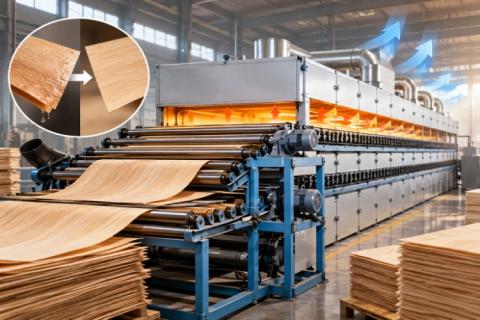
What Is Veneer Drying?
A Key Step in Veneer Production
What Is Veneer Drying? In simple terms, it means removing moisture from freshly cut wood veneers. After peeling or slicing, wet veneers contain too much water for direct gluing. We use controlled heat and airflow to bring their moisture content to a suitable level.
This step plays a major role in veneer production. It affects strength, flatness, bonding, and the final appearance of veneer sheets. In plywood and LVL plants, good drying can make the difference between a smooth production day and a very frustrating one. Nobody wants a beautiful veneer ruined by poor drying.
From Wet Veneers to Usable Sheets
Fresh veneer can contain a high amount of water. The exact level depends on wood species, thickness, temperature, and cutting conditions. The drying process reduces this water before the sheets enter grading, gluing, or further production.
The final target varies by product and process. Many plywood operations commonly target around 2–10% moisture content. Some hot-air systems aim for about 3–5%.
How Does Veneer Drying Work?
Heat and Airflow Do the Heavy Lifting
A modern veneer dryer uses heat and moving air to remove moisture. Hot air transfers energy to the wood surface and helps water move from inside the veneer. The air then carries moisture away from the sheets.
In continuous systems, the sheets travel through a drying chamber. Roller systems or mesh belts support and move the material during this journey. Different drying zones can use different temperatures and airflow conditions for better control.
Why Air Conditions Matter
Hot and humid air cannot remove moisture efficiently forever. Therefore, a dryer must control temperature, humidity, and air movement together. Fresh or dry air helps carry more moisture away from the veneer.
We pay close attention to this balance when developing drying technology. Too little heat can slow production. Too much heat can damage delicate veneers or create uneven drying.
Why Does Moisture Content Matter?
Too Wet Can Cause Bonding Problems
Moisture content directly affects veneer quality. If veneers contain too much water, the adhesive may not bond properly during plywood pressing. Excess moisture can also create steam pockets during hot pressing.
Research shows that moisture level affects bonding, dimensional stability, and joint performance. Therefore, drying should not simply make wood “dry.” It should create the right drying result for the next production step.
Too Dry Can Also Cause Trouble
Drying too aggressively creates another problem. Excessive drying can increase defects, shrinkage, and quality variation. Different wood species also respond differently to heat and moisture.
For example, studies have found different shrinkage behavior among beech and oak veneer sheets. That is why we cannot use one simple setting for every species.
What Equipment Does Veneer Drying Use?
Roller Veneer Dryers
A roller veneer dryer moves sheets through heated zones with driven rollers. This design works well for continuous veneer production and high output. It can also reduce manual handling during the drying process.
Our veneer dryer machine designs can combine controlled heat, airflow, and material movement. We focus on stable operation because consistent drying supports high quality throughout the production line.
Mesh Belt and Other Systems
Some thin or delicate veneers require different handling methods. Mesh belt systems can support lightweight sheets while air passes around them. Other plants may use press drying or batch systems.
The best solution depends on several factors:
- Veneer thickness
- Wood species
- Required capacity
- Final moisture target
- Available heat source
- Factory layout
- Energy consumption
- Automation requirements
There is no magic button here. Proper equipment selection matters.
How Can Drying Improve Veneer Quality?
Uniform Drying Creates Better Results
High quality veneer needs more than a low moisture reading. The moisture should remain reasonably uniform across the sheet. Uneven drying can leave wet areas while other sections become overly dry.
The USDA Forest Products Laboratory identifies fast, economical, flat, and uniform drying as major goals. We follow the same basic principle when considering drying systems. A stable drying result helps veneers become ready to be glued.
Protecting the Final Product
Good drying also supports the later stages of plywood and LVL manufacturing. Properly dried wood veneers are easier to handle and process. They can also support more consistent adhesive bonding.
We believe the dryer should serve the whole production line. It should not simply chase maximum temperature. Instead, it should balance speed, quality, capacity, and energy use.
How Does Veneer Drying Affect Energy Consumption?
Drying Uses a Lot of Energy
Veneer drying requires significant thermal energy. FAO reports that veneer drying can account for about 60% of total energy consumption in plywood manufacturing. Another FAO source estimates about 70% of thermal energy used in plywood production.
These figures explain why efficient drying matters so much. Even small improvements can become meaningful across a large factory. Better insulation, airflow control, heat recovery, and suitable fuel systems can all help.
Smarter Drying Saves More Than Fuel
We look at energy consumption together with production capacity. A machine that uses less energy but dries too slowly may not provide the best overall result. Likewise, extreme heat may increase output but create quality problems.
Good drying technology finds the practical middle ground. The goal is simple: remove moisture efficiently while protecting veneer quality and production stability.
What Makes Veneer Drying Effective?
The Right Settings for Each Veneer
There is no universal drying recipe. Operators should consider species, thickness, initial moisture, production speed, and target moisture content. They should also monitor the actual drying result instead of relying only on machine settings.
A well-designed system can adjust key conditions across different drying zones. This approach helps maintain more stable results and supports continuous veneer production.
From Drying to Better Production
So, what is veneer drying really about? It is much more than heating wood. It is a controlled process that removes moisture while protecting the quality and usability of veneer sheets.
At Shine Machinery, we see drying as a critical part of the complete production line. When the heat, airflow, speed, and moisture level work together, wet veneers can become optimally dried materials ready for the next step. That is the kind of result we want from every veneer dryer.